
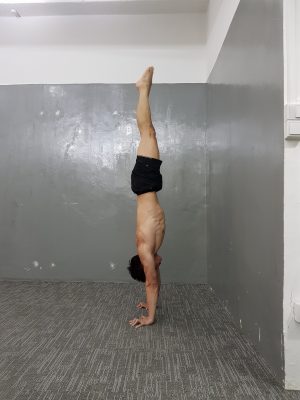
What is a Handstand? It’s standing on both hands – with your feet off the ground or above your head. That’s it.
You see gymnasts do it in every routine – even on the rings. Their legs are above their heads.
It is a growing interest worldwide to achieve this skill by the fitness community.
Why on earth would adults want to do that?
There are many reasons to achieve this skill – in addition to strength, mobility; you will be an inspiration because not many adults can do it.
It is not an easy skill to achieve – and adults have been injured learning this skill. On the other hand, when you achieved it, it has meanings at many levels – just like being known as an Elon Musk or a Richard Branson.
Building a successful business has many equivalents to learning handstands.
Not sure? Read about my experience in building a business and learning handstands.
1. Working the Core – Defining Your Values
The handstand requires strong trunk muscles (abdominals & back) – the core to hold the legs above the head.
The core is part of the structure – without it, you can’t sustain the position long enough to even take a quick photo.
Often times, the enthusiasm (or is it the ‘instant results mentality’) drives adults to spend little time in developing the core; instead they get onto their hands without preparation.
A significant number of new businesses and even existing ones have yet to define their values. Have you?
Values drive how you build your business, form partnerships, and treat your staff, clients and a lot more.
How many businesses have failed because of issues amongst the partners?
It can be traced to lack of alignment of values amongst the partners. One wants to be change, another prefers a wait and see – sounds familiar?
Have you been in a situation where you saw a market opportunity but your partner doesn’t? You spent lengthy hours on discussions that go nowhere leading to frustrations and sooner or later to mistrust.
How about your staff? Are they aligned with what you want to do?
We can complain about how difficult it is to find the right staff. But we can’t dismiss the fact business owners have to hire and train people and not hope staff will know what to do.
Defining your values and aligning them with your partners is top priority.
2. The Progressions – Your Business Processes
A world-class gymnast spends years practicing drills – known as progressions – correcting errors, checking progress and do it all over again. When we finally see gymnast at the Olympics, we see the final product – we don’t see the progressions or the hard work.
It’s the same for businesses. There are processes required to deliver maximum client  appreciation. Today’s business can’t afford to deliver less than client appreciation. Note the difference with client satisfaction.
And processes lead to higher predictable results.
How predictable is your business ability to acquire or retain clients?
You don’t know, do you? But if you can predict the acquisition or retention, how much stronger your business can be.
Why are processes important?
I used to frequent a small gym for personal training, with the same trainer for a number of years. At one stage, there was frequent changeover of the receptionists. Every time I went I had to give the trainer’s name.
How would you feel not being recognized after all these years?
Some may blame the receptionist for not doing the job. But changing receptionist is not the answer – are the processes in place and how are they be reviewed and updated on a regular basis to reduce errors?
3. Excellent Coach or Mentor – Accelerate Your Leaning From Others
This is the norm at worldclass sports. The athlete has an excellent coach – who builds on the athlete’s talents through his ability to coach and expertise.
There are adults wanting to learn the handstand – however, unwilling to pay for the appropriate coaching. As a consequence, some developed injuries that were costly to resolve or led them to give up.
Obviously, there are costs involved – time and/or money for coaching or attending workshops.
What are the costs of business failures? Is it money alone? What about time – years spent? What about emotional consequences? It’s not unheard of failed personal or family relationships because of failed business.
Learning from others help to minimise the risks. It’s risky to use only what you know – the world is changing too fast and unforgiving to those slower to adapt to changes.
There are also business owners who spent lots of money on continuing education or having a coach – but they don’t apply i.e. act on the learnings.
As the saying goes “You can only bring the horse to the trough – you can’t force it to drink.”
4. “Almost” is not good enough
At world-class levels, athletes can lose by mere milli seconds or a gymnast can lose by a few points. After years of training, it’s heartbreak to not be the number 1.
With adults learning the handstand, some would say, “I am almost there” – yet for handstand you either can or cannot.
What about business? Almost breakeven is still negative profit. These are times you have to take a hard look at your business and to plan to exit or change. When you dwell too long on the “almost” there scenario you mighe end up with higher losses. This is also a time when a coach or mentor can help you “see the forest from the trees”.
An insight from gymnastics:
“Being a gymnast is having the strength to hold on and the courage to let go”.
5. Consistency is more important than intensity.
For fitness training you require to exercise 2-3 times per week to see results. You can’t do an intense an hour per week or 2-3 hours in one day per week and expect to see results – your body does not improve that way. It’s hard work to train consistently.
A world-class athlete knows that – he trains consistently for months and years. He faces obstacles and yet he beats them to win the race. Watch this video of Usain Bolt in training.
“The work is behind the scene. The competition is the easy part” – Usain Bolt.
Building your business is a marathon. New owners start off highly enthusiastic, loads of energy and start to falter when they hit problems or skip things they don’t like to do.
You read about many successful businesses – mostly the good part but not always “behind the scenes”.
Some activities new owners tend to skip are reviewing the financials or dashboard on a regular basis, engagement with partners, clients and staff. These activities are time consuming but consistency will detect and resolve problems early.
So Do You Do Physical Training?
How we approach physical training is no different from building a successful business. Why some worldclass athletes are coaching entrpreneurs or businesses after their sports career.
However, to be phsyically fit is no longer recreational. It’s imperative business owners place priority in physical training.
From Usain Bolt on Building Confidence
“Training gives you confidence and this helps your state of mind. I know if I’m in good shape it’s going to be very hard to beat me, this confidence is very important in performing well.”